mallorys_camera: (Default)
RTT—God bless his little networking soul—conjured up Brandon, a college pal I met on several occasions when he was crashing at one of the Syracuse U houses.

“All my friends love you, Mom!” RTT assured me brightly. “They think you’re cool!”

I don’t care if they think I’m cool.

I just want them to move my few bits of furniture without ruining them.

Which Brandon may actually be in a better position than most to do since he ultimately dropped out of Syracuse U to become a plumber and now makes $110 an hour and so, did not agree to move my measly little sticks of furniture for buck$ (though, of course, he will get buck$) but as a show of Friendship & Fellowship toward RTT!

Saturday is the big day.

I must invest in bubble wrap and scrounge up some old blankets at Good Will.

###

Other than that, I continue Remunerating, tromping, and generally feeling feeble and fragile.

I keep flashing on Guatemala:


Apparently, they made a miniseries out of Jonathan Strange and Mr. Norell, a book I liked enormously as the anti-Lord of the Rings heroic fantasy—I loathe Lord of the Rings—and also as a pastiche of all that’s best in the prose styles of Jane Austen & Charles Dickens.

I should reread the novel.

The series is mostly excellent despite the fact that I imagined all the characters very differently.

Except for the very last episode. This is the episode on which they blew their CGI effects budget, and none of it was very convincing.

###

After watching the dancing in the court of the Gentleman With the Thistledown Hair, I am moved to note that the word “glamour” was originally used to describe the bioluminescence of the glowworms used to light faery revels and so has a strong suggestion of deception, delusion, and maya, not Paris runways and the cover of Vogue Magazine. Or possibly Paris runways and the cover of Vogue Magazine are deception, delusion, and maya.

###

I must also note that Mabel is anxious to be packed:

mallorys_camera: (Default)
I worked all day, and then, by the time I finished, it seemed too cold to do anything outside.

Seemed like it was too cold. Because really, it wasn’t.

I ran into Loraine near the mailboxes. “This day!” she grimaced. Which I took to be consensus: Stay inside.

Staying inside was probably a mistake.

Because it’s supposed to rain all day today

The world is an awful place.

And I’m very lucky—except I don’t feel lucky.

###

Anyway.

I always tell myself that I can chain myself to the desk when the coffers get low and then just Remunerate away till they overflow once more.

But Practice does not follow Theory on this one.

I always end up feeling deeply sorry for myself: Poor you. The world is having fun! And you’re not.

Except—demonstrably—the world is not having fun right now.

And yet still, I feel sorry for myself.

###

I’m not sure why I keep flashing on this one day when Ichabod & I tromped almost the entire perimeter of Antigua:


I remember feeling this kind of restless on that day, too. Like, Here you are where you wanted to be, but you’re still not feeling lucky.

Does anyone anywhere ever really feel lucky?

Or is it always like driving on a crowded highway: You never feel as though you’re actually moving until you pass someone else?
mallorys_camera: (Default)


On Easter last year, I was in Antigua, Guatemala, watching the largest Easter celebration in the world, an odd combo of Andalusian and Mayan traditions for the floats are Catholic but the carpets—called alfombras—the cucuruchas tread upon are made from sand & sawdust dyed in bright colors and decorated to reflect Mayan myths. The air is thick with incense. It’s quite the scene.

###

Yesterday, I spent an enormous amount of time on the phone, which is quite unusual for me.

Like I talked to Stew for two hours. A far-ranging conversation that began with the latest hijinks of my vastly dysfunctional family—Janet is traveling to Berkeley to sell the House!—and ended up with Stew telling me all about his family, which is like something out of Downton Abbey.

Among the familial artifacts Stew has retained is this:


A fully functional violin made around 120 years ago out of clear plastic.

He’s shown the violin to a few people over the years, potential buyers—one associated with the Smithsonian—who have quoted him prices ranging from $10,000 to $1,000,000. (I suspect a lot of dope may have been smoked to produce that last quote.)

“You’d need to authenticate its provenance to get an accurate quote,” I told Stew. “Like was it manufactured as a prototype? Or through some kind of assembly line process? And who manufactured it? Who designed it?”

“Well, you know, Ichabod said he might be interested in looking into that,” Stew said. “So, I gave him all the old albums. My grandmother’s diary.”

Adventures in Musicology!

You could write a really interesting novel exploring the provenance of a transparent violin!

###

Other than phone marathoning, I tromped & read more Erotic Vagrancy.

Biography is bricolage—bricolage! be still my beating heart!—as is “Ivanhoe”, writes Roger Lewis.

What I like about Taylor’s Rebecca, therefore, is the demureness, the solemnity. Everything is being banked up, awaiting future use. She has to spend a lot of the film looking after Felix Aylmer—“Ivanhoe” contains Felix Aylmer and Finlay Curry—who is as doddering as ever and whitters away about how, “My heart broke long ago, but it serves me still,” surely a cardiological miracle. He’s Isaac of York, a Jew who pledges money for King Richard’s ransom. Everyone seems very against this scheme, especially Prince John and his henchman De Bois Guilbert—George Sanders, who struts about in a suit of chain mail…

…”I shall possess you, Rebecca, if I die for it,” he tells her, though what good would that do him? Not one to give up, he comes to her room, or turret, to rub in his intentions. “Rebecca, you mistake the nature of our bargain. I want you alive, not dead”—Taylor has started to heave herself over the parapet. “When next I come to you, meet me with desire on your lips and fire in your breast, or no man’s life is saved this day!” Is that how Sanders spoke to Zsa Zsa Gabor and Benita Hume, to name two of his wives?


###

Okay! I had to track down & watch the movie Ivanhoe after reading that, right?

The movie is predictably awful.

But Elizabeth Taylor is, indeed, astoundingly beautiful in it. In the age before plastic surgery!


Now. I’ve never had the slightest interest in Walter Scott or any of his works.

But then I remembered that Ivanhoe is actually the central motif in Edward Eager’s Knight’s Castle.

And whatdiya know! Edward Eager’s copyrights have expired, and it seems that no one was particularly interested in renewing them! So, Knight's Castle is right there on Gutenberg!

https://gutenberg.ca/ebooks/eagere-knightscastle/eagere-knightscastle-00-h.html

Edward Eager is one of the great children’s books writers of all time, a kind of American version of E. Nesbit, who is the greatest children’s book writer of all time.

So I spent a very happy evening curled up with my laptop and the kiskas, reading.
mallorys_camera: (Default)
Day Who-Can-Remember? of this damp, chilly, grey, featureless weather.

Weather forecasts all say a week more (at least) of the same to come.

I began thinking this void I’m feeling lost in might be related to the weather. I mean, yeah, yeah, yeah, life is meaningless, the world is a shit hole, the ceremony of innocence is drowned over and over again like some kind of dunking game at a tawdry carnival, but that's same as it ever was, no? A good deal of the time, I don’t let that get me down.

Maybe what I’m feeling is a flare-up of seasonal affective disorder.

So I did gummies last night.

And I will do more gummies today.

And since I have very few gummies on tap, I will drive up to the fabulous Berkshires early next week to stock up.

###

Yesterday was productive, though.

I got within shooting distance of the end of another Remunerative Project (a short one) and watched a weird movie called Triangle of Sadness that has become a cult favorite of sorts: The GenZers and Millennials who like it are too young ever to have heard of Lina Wertmüller.

###

While I was pounding away on the economic and social implications of outsourced hospital emergency departments, a memory as powerful as perfume wafted up from the limbic portion of my brain—

It was a recent memory but nothing special: I was in the backyard of the Antigua Airbnb, taking laundry down from the line.

So immersive in that short moment! Such a strong sense of what it was like to be sharing domesticity with my adult son.

I missed Ichabod so powerfully in that instant.

(And a moment later, an email from Ichabod appeared in my Gmail queue, so that part of my brain is still working.)

###

Guatemala was fabulous, but the most fabulous thing about the trip was that I got to spend 10 days with Ichabod.

We got along really well.

I mean, I don’t know how much of it on his end was, I am here humoring my aged mother…

Possibly, quite a bit.

He was very, very nice to me.

But from my perspective, it was a complete pleasure, and there was nothing I would rather have been doing.

###

Early in the trip, I’d had a revelation about our disparate communication styles (and the divergent life philosophies that underlay them.)

I’m a storyteller; Ichabod is not.

Give me two facts: I will immediately conceive a narrative about them based on a hundred variables whose influences I interpret like a Roman haruspex reading entrails or HAL 9000 in 2001 running mad regression analyses.

The narrative will probably be more true than false: I’m a close observer.

But still—it will be a made-up story.

Ichabod, on the other hand, dislikes imposing uncorroborated narrative on fact. Thinks it’s a dangerous practice. Thinks intuition is little more than a sophisticated rationale for profiling and judging. Strives to remain unjudgemental.

Once I grasped that, I understood Ichabod so much better.

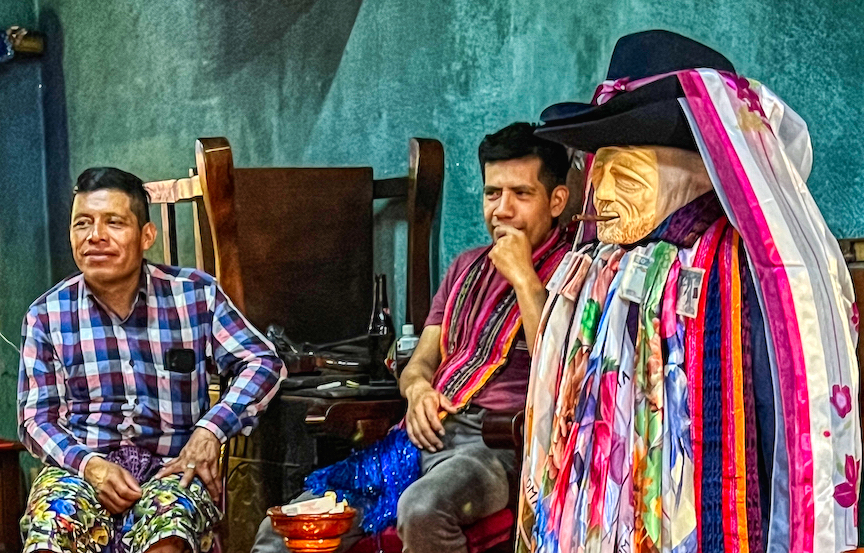
Maximon

Apr. 18th, 2023 01:18 pm
mallorys_camera: (Default)


Maximon is the little dark guy lurking near the carnival archway, watching you from a distance. Raising his eyebrows in a premonitory smirk—you shouldn’t be able to see it at that distance. But you can.

Related to the all those other trickster gods, Anansi, Loki, Coyote, Hermes, the Monkey King. But also to Jesus and Saint Peter. Though not to Saint Paul. (Definitely not to Saint Paul.)

His name is derived from Tzʼutujil, a sister language to Kaqchikel and Kʼicheʼ. It means “Mister All-Tied-Up” (from Ma, the male honorific, and ximon, the present perfect of the verb “to knot.”)

Tzʼutujil these days is mostly spoken by the residents of the gritty municipality of Santiago Atitlán, but once was spoken in 20 or so villages in the surrounding highlands that mysteriously disappeared during the Guatemalan civil war.

Maximon gets around. There’s a small underground chapel in the highland volcano town of Zunil where Maximon wears sunglasses and trades in his silk scarves for bandanas. He shows up once a year in the dreary little village of San Andres Itzapa to celebrate Saint Simon’s feast day, October 28: Saint Simon is one of his aliases. There is said to be a San Simón Indigenous Spiritual Temple in Brooklyn.

Mostly, though, Maximon hangs out in Santiago, which, as I noted before, was Ground Zero for the Guatemalan civil war. He travels from household to household, a week’s stay at a time. He leaves signs on the road like the mysterious arrows that traveling circuses use to mark their passage from town to town; you have to know how to see them. Otherwise, you can ask a tut-tut driver for directions or a barefooted child trawling for alligator lizards on the shores of the lake.

In order to be one of Maximon’s keepers, you have to take an oath to stay drunk the entire time he’s in your house.


Maximon is the god of the crossroads, those portals of opportunity where suicides are buried. He’s a shapeshifter: Most people who encounter him don’t recognize him. He’s the beggar who smiles at you from the corner of the subway platform; he’s the billionaire whose eyes lock with yours as he slowly raises the tinted window of his chauffeur-driven limousine. Sometimes he’s a beautiful young girl whose innocence is a disguise; other times, he’s a magpie or a donkey or a lost dog. He opens doors in walls that sometimes lead to gardens and sometimes lead to tracks in the rush of an oncoming train, but always, always, what you choose for them to be though you may not realize you’re choosing.


Of course, Maximon grants wishes.

But I didn’t make any.

There’s always that Monkey’s Paw clause attached to the wishes you cajole from magical beings: They come true but most of the time, you end up wishing they hadn’t.

It’s best to just keep yourself open to the Universe, let the Universe use you whatever way it wants to.

And remember to try and have a good time.


In the 10 days I was gone, spring arrived in the quaint and scenic Hudson River Valley.

Trees that were totally bare when I left are erupting with green. Magnolias, redbuds, and (despised) Bradford Pears in high flower. Daffodils are everywhere! They’ve been blooming so long they’ve even begun to shrivel.

I was energetic yesterday. Tromped, remunerated, and carried on like a pro.

Today, though, I’m a zombie.

Could be the weather: It is chilly, blustery, and overcast. Apparently, it’s even snowing in the Catskill foothills.

All I want to do is sleep.
mallorys_camera: (Default)


Guatemala was utterly FABULOUS.

Above is the classic Antigua shot: Arco de Santo Catalina with a sliver of the Agua Volcano in the background.

Though I lost so many brain cells on the absolutely grueling trek back, that I have to fight through a layer of mental white noise this morning to access those memories—a flight that left Guatemala City at 5 am in the morning, a two-mile march through Miami’s Passport Control and customs (I logged it on my Fitbit), my discovery once I finally got through security that American Airlines had oversold my flight so that despite having bought my ticket in January, they did not have a seat for me!

I had to play the senior citizen card.

See how old I am? I am old! If you don’t find a seat for me, I may stroke out right here & now, & froth at the mouth! That will make for some really unpleasant Yelp reviews! Plus, did I mention I have 55,000 Instagram followers? <—NOT TRUE.

And it worked.

I got on that plane!

Fortunately, I have no compunctions whatsoever about making scenes in public.

Being somewhere else is fabulous.

Traveling somewhere else is almost always a pain in the ass.


Antigua is like a Third World Disneyland.

A tiny little place, maybe two square miles in total. Five thousand feet above sea level, and yes, I did feel it the first day I was there. And all cobblestones, which—trust me!—are not easy to walk four or five miles a day on.

Much of Antigua is in ruins, like the Compañía de Jesús (above), a Jesuit compound constructed in 1655, which was one of the most important Catholic sites in the New World back in the 18th century when Antigua was the seat of Spanish colonial government.

In 1755, an earthquake took Antigua out, and the capital was moved 25 miles to the east to Guatemala City.

The Mestizos left behind had neither the resources nor the inclination to take the ruins down, I guess, because the ruins are everywhere, giving the tiny city a rather Borges-ian feel, as though it is neither entirely of the present nor of the past:


Of course, I had come to Antigua on a specific mission. I wanted to see Semana Santa, the week-long Easter celebration that preserves many of the religious observances of medieval Spain and introduces a few of its own, specifically the alfombras, originally derived from Mayan ritual: Mayan gods, you see, never touched bare ground; they walked on flowers. As they passed over the flowers, the flowers turned to dust:


Easter effigies of the Christ were pulled over the alfombras. Eventually, the alfombras came to be made of hardier materials like sawdust:


Cultural syncretism is one of my very, very favorite things. Looking at the alfombras, it’s hard not to be reminded of Tibetan Buddhist sand mandalas whose celebratory destructions are another reminder of the transitory nature of all material life…


Processions take place throughout Easter Week, the various confradres—I suppose the equivalent of Mardi Gras carnival clubs—traveling to Antigua from miles away. The confradres wear different costumes; the ones on Good Friday were dressed in purple and red Arab garb, while the ones on Easter were dressed in black like the Spanish Inquisition’s junior auxiliary.

Easter night, we gathered with thousands of others in the Parque Central to watch the festivities:


That incense was something! Almost a hallucinogen.

On Easter night, the effigies were not of Jesus but of Mary, the converso Demeter, and various Pieta depictions.


All the processions were followed up by New Orleans-style marching jazz bands:


I’m not a big fan of Jesus generally, but if you gotta do Jesus, I prefer High Church to Low Church. High Church has got a lot more of that old animistic, earth magic.


On my actual birthday, I journeyed to Lake Atitlán and the gritty city of Santiago to visit Maximon, the last Mayan god.

I once wrote an entire novel about Maximon.

So this introduction was long overdue.

Santiago was ground zero for the not-so-very-long-ago Guatemalan civil war in which CIA-backed government operatives slaughtered 200,000 Mayans that we know about but more likely three times that number. The city doesn’t appear on any backpacking vagabond lists of Fabulous Places to Visit in Guatemala.

But I liked it a lot.

However, I have a shitload of stuff to do today, and I’ve already spent far too long writing this.

TBC mañana.

Or not.
mallorys_camera: (Default)
Max is in Antigua, Guatemala for six weeks doing the Spanish language immersion thang.

He emailed that he’d arrived safely, and that he was perplexed by the city’s odd post-apocalyptic ambiance – the cobblestone walkways, the strange Baroque rubble. Apparently, he hadn’t read up on the great earthquake of 1773, so devastating it nearly toppled the Spanish Conquest so that Spain’s king, Charles III, had to order the relocation of the capital city to the Valley of the Hermits, 30 miles to the east (today’s Guatemala City.)

Naturally I wanted to impress the kid with his mother’s vast knowledge of local history and anthropology, so I started foraging around in my trove of journals, thinking that I could pass some scribblings from my own 2002 trip to Guatemala off on him as spontaneous prose outpourings.

Unfortunately, I hardly wrote anything in my journal while I was in Guatemala – or in the months after I returned, though I did write a horror novel that took place in Guatemala.

I did find this fragment, though. Reading it across a gulf of 13 years, I think it’s quite good in a Hideous Kinky kinda way:

11390346_10206621885323334_1472993586137140123_n


How anyone could bring a child so young to the Third World was beyond Lucy's comprehension. Beautiful though the village was, packs of feral dogs roamed its cobbled streets, and sewage drained directly into the lake where the hippies swam. Lucy, of course, was the type of mother who didn't want to let her kids out of the backyard without first checking to make sure their vaccinations were in order. But Teresa and Milo were artists, free-spirited. Maybe they knew something Lucy didn't.

Teresa and Milo had turned Lucy on to the cheap eats at the commodor, the café frequented by adventuresome tourists and the more intellectual among the townsfolk.. Lunch had become a standing date in the three days since Lucy had arrived. A vegetable platter with boiled potato, shredded carrots, a mound of avocado.

The little girl refused to touch any of it.

"Eva, you have to eat," Teresa said, frowning at the child.

The little girl ignored her. "Tell me more about the magic dog," she begged Lucy. She had the enormous blue eyes and long blonde hair of a character in an old-fashioned children's book: Alice in a Highland Tropic Wonderland. "The dog can fly, right?"

"I'm not sure the dog can fly," Lucy said. "I think you just order up special dreams from the dog."

"Eva, leave Lucy alone and eat," said Teresa. "Carrots. Eat the carrots. Milo and I practically lived on carrots until we sold our first painting."

The commodor fronted a concrete playground. Two boys swung on a truck tire attached to a swing set. Eva watched.

"It's amazing how high those kids can go, isn't it?" said Milo.

"The dog can fly," Eva said. "I know the dog can fly."

"Eva has a dog, don't you Eva?" said Teresa.

"Xena," the little girl nodded. She would look just like her mother in another thirty years or so, Lucy thought, if she had her mother's cash flow problems.

"Cats can fly," Lucy said. "When it comes to magic, cats are the ones to trust. Dogs are merely magic enablers."

"What's an enabler?" asked the little girl.

"Grown up stuff," Teresa said. She picked up Eva's fork and shoveled carrots on to it.

One of the skinny dogs was sniffing for scraps along the wall that separated the playground from the commodor terrace. It was an ugly dog with its scrappy coat and ragged tail, but it had enormous, appealing eyes like the cow in a Christmas manger scene. From its belly hung teats that had been sucked so dry they were just flaps of skin. The boys leapt down off their tire. One of them picked up a stick.

"Eat," said Teresa, bringing the fork up to her daughter's lips.

The boy with the stick walked up to the dog and hit it. Hard. The dog yelped but didn't move. The boy hit it again.

Lucy glanced over at mother and daughter. Tears in the little girl's eyes.

"I was just like that when I was her age," said Teresa, fork in mid-air. "It killed me to see an animal in pain. Eva, people are so poor here that there isn't enough food to feed the doggies which is why you need to eat your –"

The little girl shook her head, unpersuaded. "I don't like carrots," she said.

11227769_10206621885403336_4037246261068898137_n


The true tale of the D_________ family, in other words – the amazingly beautiful little girl, Annabella; her warring parents, Dori and Joe.

Two days before I left San Marco la Laguna, I was woken up by Joe at 4am – Annabella was having a seizure. I was a nurse; he figured I’d know what to do.

Annabella’s forehead was scalding hot so I figured she was having a febrile seizure. I dispatched Joe for a bottle of Carol’s (NHRN) best bourbon – Carol and Joe were sleeping together, unbeknownst to Dori so I figured that even though Carol was/is remarkably coldhearted, she would pony up her stash – and proceeded to give her alcohol baths while we waited for the launcha that would ferry her back to Pana, which is what passes for civilization along the shores of Lake Atitlan.

Later, in her kitchen, trying not to be obvious about grilling me for details – Where did they go? I wasn’t through with him! – Carol told me she thought Annabella was acting out.

“She thrives on the attention,” Carol said.

This was extreme even for Carol.

“Carol,” I said. “She had a really high fever. Sometimes, when kids run high fevers, they have seizures. I can assure you: This was not something she was doing for attention.”

Carol narrowed her eyes at me. “Her parents are miserable together – anyone can see that.”

“That may be true, but it has nothing whatsoever to do with what just happened with that kid.”

“She’s reflecting her parents’ situation,” Carol said.

###

Carol Reports occasionally drift to me still as part of the flotsam and jetsam of general gossip: She’s written more novels; one of them got made into a movie; the movie bombed at the box office. She remarried, a rich lawyer with a very big house in the Oakland hills. The rich lawyer has pancreatic cancer and will likely die soon, leaving Carol a rich widow what with the life insurance and the market value of the very big house in the Oakland hills.

I think of Carol as another one of those women whose psychic mana is so-o-o powerful that the men they marry realize on some subliminal level that they’ve got to sacrifice themselves to make that mana stronger – Erica and Maria are the other two women I’ve known like that. Gil conveniently developed a brain tumor when Erica didn’t need him around anymore; Chris forgot to close a hatch on his Cessna, crashed his plane into the Simi Hills. One might be tempted to describe such women as “Black Widows,” but I think that misses the more subtle nuances.

Carol is a pretty unpleasant human being, but I will say, too, that she was one of the best writing teachers I’ve ever had in my life. She really taught me a lot about the craft of writing – which is odd because her own fiction remains the gurgley, obsessively personalized stuff, a kind of high-brow Jodi Picault, that I find really, really difficult to read. Maybe she was parroting back stuff she learned from Salinger.

Dori and Joe divorced shortly after they got back to the States.

Dori was very, very bitter when she found out about Carol and Joe – I kept in touch with her for a while – but being an eminently practical woman despite this crazy, mixed up notion that she was an artist, decided to move to (ulp) Alabama.

“It’s cheap,” she told me.

Dori opened up a gallery in Birmingham, and manages to support herself through that, her art, and regional art tours. She remarried.

Annabella grew into a breathtakingly gorgeous young woman.

I don’t know what happened to Joe.

###

I seldom read through any of my past journals, so getting caught back up in 2002 again, through my own words, was an odd experience. I came home from Guatemala and immediately began writing Saturday Night in the Sky. I sleep-walked through my various domestic duties. I mostly wrote in my journal about the act of creation – how crazy difficult it was, how it subsumes one, how it mixes up the polarities so that your imagination becomes the real world and everything else becomes a kind of grayed-out phantom universe.

That was the year that Ben’s mother had her heart attack, and Ben flew off to New York to sit at her bedside for many weeks.

That was also the year that I found out about Ben’s affair. That discovery was what finally jolted me out of my creative reverie.

“I didn’t want to tell you because I thought it might keep you from being able to finish the novel,” Ben said.

But I knew that was a lie. If I hadn’t done the detective work, he never would have told me.

Really, I should have ended the marriage then.

But I didn’t.

My 2002 journal is filled with the names and half-finished stories of people I no longer remember. It’s hard to salvage the stories when you don’t know/remember what led up to them, what happened next.

This made me think that I should be a bit more diligent about recording the various stories that are happening now.

Masks

Jul. 25th, 2004 08:33 am
mallorys_camera: (Default)
Going to a gift show is kind of like going to Las Vegas. For maybe 8 hours you wander around delighted and amused by the pretty colors, by the endless inventiveness of humankind, the infinite variety of kitsch - wow! so many adorable ceramic roosters - and then it hits. Bam! The hollow mirror.

Fortunately a day trip makes for easy in and out. A lot of driving though. Two hours into Oakland and then another hour on BART to the Moscone center. BART on weekends is the desperado highway, a lot of people with stringy unwashed hair, scratching and furtively mumbling to themselves.

I've lived long enough away from the Bay Area so that the freeways and cross streets are no longer second nature to me. Got off 880 at Fruitvale, tried to find the BART station and got lost. Getting lost took me within 2 blocks of my old East Oakland cottage, only guess what? I couldn't remember what the cross street was.

Turn-out at the gift show was surprisingly low leading me to believe that the economy is not recovering quite so robustly as the various talking heads on CNN market watch would have us believe. When people are turning their wallets inside out for gas money, there's very little left over for ceramic roosters. I was wandering by a booth swathed with bolts of blue and white French provincial fabric, heard a half-familiar voice dissing the sales rep good-humoredly - “Well, yeah, it's gorgeous but the price point is way too high. I'd have to sell this for - what? $22 a yard? It would be on the shelf for a year.”

Paul. From Guatemala.

Hesitantly, I reintroduced myself.

“Well, of course, I remember you. That was - what? Two years ago?”

“Almost three,” I said. I knew he was lying.

“What are you doing here?”

“I have a store in Monterey.”

“What do you sell?”

“Hot sauce. And kitsch.”

“Hot sauce and kitsch,” he grinned.

I'd had a rather long discussion with Paul in San Marcos del Laguna about entrepreneurship. I doubt that he remembered. But it had made an impression on me. Paul is my model for a successful entrepreneur. He has a store in Oakland called Poppy Fabrics that is just a fabulous place to lose yourself for an hour or so, filled with lovely things to touch and see and with helpful yet discreet salespeople who leave you alone until you need help.

“Didn't you ever think of turning it into a chain?” I'd asked him then, and he'd replied, “Why would I want to do that? I make enough to live very comfortably with a lot of free time left over. I'm not greedy enough to want the hassle of managing a chain. Or maybe I'm too greedy. I like my leisure.”

Not a handsome man but a very attractive man. Probably looked a lot like Woody Allen when he was younger.

“So what about the literary pursuits?” he asked.

“Oh, I'm still doing those,” I said. “But you know, starting a business is a creative project too.”

“Oh absolutely. Absolutely it is. You look just the same. You know, I do remember you. It was just the context that eluded me.”

“Right,” I said.

“The problem with getting older,” he said and laughed.

“Right! You only have a finite number of brain cells and if you started remembering every person you meet, you'd have to erase backloads of seventies hits from your frontal lobes. And that would be wrong.”

“That's it. That's it exactly.”

“G-L-O-R-I-A - Gloria,” I said.

And he laughed, knowing he would not remember me the next time if we happened to run into each other again.

I loaded up on the usual chili-themed kitsch - salsa dishes, spreaders, cutesy refrigerator magnets, barbecue books and posters.

Then as I was leaving, I saw a small, unprepossessing booth decorated with the most extraordinarily beautiful masks I had ever seen in my life. Masks from Venice. Carnivale masks. I bought $300 worth. I shot my wad. No one will ever buy them - the store is absolutely the wrong venue for merchandise like this, they belong in an art gallery - but I had to have them, I had to own them.

The man selling them was one of those Venetian Italians with the big dark eyes and small mournful mouths.

He barely spoke English. He perked up when he saw my name.

Parlo Italiano, Patrizia?” he murmured.

Un poco,” I said. But I was lying too.
mallorys_camera: (Default)


And who should show up in town yesterday but Dori DeCammelis, the Real Life prototype for Mari in my novel, last glimpsed on the deck of a ferry receding into the misty distance of Lake Atitlan. She was crouching over the prone body of her seven year old daughter, Annabelle. Annabelle had just had an epileptic seizure. She was about to have another. The ferry, eerily enough, was named La Nina.

Several hours earlier there’d been a knock on the door of the posada where I lay sleeping fitfully.

Joe. Annabelle’s father.

"Something’s wrong with Annabelle," he told me. "Please come."

We took the lake route back to the big house. There was no moon, it was very dark. I almost wrenched my ankle negotiating tree trunks and cinder blocks rotting in the stagnant waters.

Up at the main house our hostess Joyce Maynard was awake, filling a kettle. She raised her eyebrows quizzically as I passed – hysteria that she herself did not initiate was something she disapproved of.

I climbed the stairs to the tree house and opened the door. Dori was hunkering down in one of the corners of the room and on the bed, covered with as many Guatemalan blankets as her parents could heap over her lay Annabelle.

"You’re a nurse," Dori screamed. "Do something!"

Well, actually I haven’t been a nurse for many, many years but I knew enough to determine that Annabelle was having seizures because she was burning up. "Get those blankets off her," I ordered. "We need to bring her temperature down."

There was no medicine in the sleepy village of San Marco del Laguna. No Walgreens, no children’s Tylenol. I marched back into our hostess’s kitchen, grabbed a bottle of her cognac.

"That’s expensive stuff," said Joyce.

"Medical emergency," I said.

I sprinted back to the cabin where Annabelle was convulsing and started bathing her with the cognac to bring her temperature down. Whaddiya know. The ploy seemed to work. There were no thermometers in this part of Guatemala, but Annabelle seemed cooler to the touch. She moaned when I touched her, but did not open up her eyes.

Now was not the time for a lecture on the inadvisability of traveling in the Third World with a young child.

"What should I do?" cried Dori.

"If it was my kid, I’d get her the hell out of here pronto," I said as gently as I could.

Dori started bashing her head against the wall. Joe turned to me wearily. "Should we try to find a doctor in Guatemala City?"

"Your call," I said. "Personally whatever my beef with Western-style medicine, nothing beats a nice shiny American ER in times of crisis. I don’t think I trust a Guatemalan ER quite as much. I’m pretty sure she’s having febrile seizures. She probably picked up some bug, got dehydrated. In Guatemala City they have pharmacies. You’ll be able to score some Tylenol. You can get her safely on a plane. Get her to an ER, they’ll pump her full of IV fluid. She’ll be fine. But you need to do that as fast as you can."

"What about our things?" said Joe, looking around at their bags.

"Leave me your address," I said. "I’ll figure out a way to get them to you."


Joyce stood with me on the dock, watching the ferry move into the distance. "It’s going to be very expensive sending them their stuff," she said.

"They’ll pay me back," I said.

"They’ll never pay you back," said Joyce. "They have no money."

I sighed. "Well then, it’s an act of charity. For God’s sake, Joyce, it’s a medical emergency."

"No, it’s not," said Joyce. "Her parents aren’t getting along. Can’t you see that? Annabelle is acting out. This isn’t real. And you’re encouraging it."

My mouth fell open.

I still had enough nursing chops to know: the kid was genuinely ill. Not irretrievably ill. Kids get sicker much faster than adults but they also turn around much quicker. Still, there was nothing histrionic about Annabelle’s symptoms.

Joyce was flitting around the kitchen. "Shall I fix you some coffee?" In her melodious, lilting voice she was filling me in on the horror that was Dori and Joe’s marriage, and how the little girl was completely out of control, like one of the children in The Turn of the Screw, doomed to act out her parents’ pathology. I dimly recalled from reading Joyce’s much maligned memoir At Home In the World that something similar had happened to her, either as a child or a parent. So that was the grid she was using. She could only filter experience through her own monstrous self-absorption. I felt utterly repulsed by her.

Now a year and a half later, Dori was here on the Monterey Peninsula, working on a feature for Coast Living on the Carmel art gallery scene. Dori and Joe had divorced two months after their Guatemalan adventure. My diagnosis had been correct. Annabelle had had a febrile seizure brought on by some Third World crud in her blood stream. She made a full recovery though subsequent follow-ups with neurologists had determined that she might be borderline for some other sort of petite mal syndrome.

"That’s probably true for some significant percentage of the general population," I said. "Only they never have febrile seizures, so it’s never diagnosed. I know I could sit around for hours on end staring out of windows with my eyes unfocused."

Dori laughed. "Can I tell you something? Joyce and I were friends for a long time. So I called her as soon as Joe and I broke up. And she never called back. And then two months later, I finally get this short email from her: she’s sorry to hear that my marriage broke up and by the way, can she have the rights to one of my paintings free? They’re reissuing To Die For and she wants to use it for cover art. She only wrote me because she wanted something out of me!"

"What did you say?"

"I said sure, go ahead." Dori laughed. "What the hell. At this point, I just want to move on with my life. But I told her that she’d have to clear it through Joe because that was one of the paintings we both worked on. And at that point, I wasn’t communicating with Joe so she’d have to hunt him down on her own."

"So, did she?"

Dori laughed again. "She had a hard time tracking him down. Wrote me angry, vituperative emails like that was somehow my fault. Then one day I get this 4000 word email from her – she’d finally found him, they’d talked and she totally took his side in the divorce, thought I was impossible and told me that in fifteen years I would really regret tearing my family apart – because it’s been fifteen years since the end of her marriage, and she really regrets her divorce."

"And yet she got so much mileage out of her divorce in her book!" I said brightly. "Can I tell you something? She’s probably going to fuck Joe."

"Yeah, yeah. I figured. She was always going on about how gorgeous he was when we were married," said Dori. "I don’t care. She can have him."

Profile

mallorys_camera: (Default)
Every Day Above Ground

June 2026

S M T W T F S
 1 23 4 5 6
78 9 1011 12 13
14151617181920
21222324252627
282930    

Syndicate

RSS Atom

Most Popular Tags

Style Credit

Expand Cut Tags

No cut tags
Page generated Jun. 15th, 2026 01:42 am
Powered by Dreamwidth Studios